Home → Systems & prices → 6 Stage Standard PRO Reverse Osmosis
Best seller
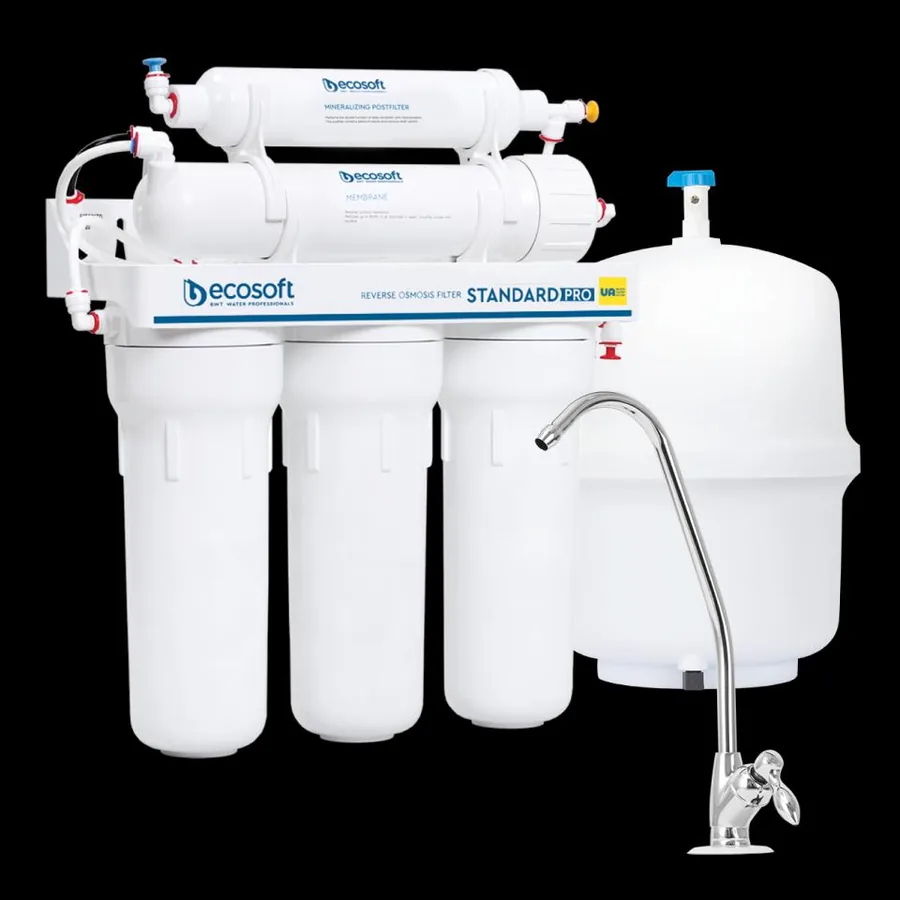
6 Stage Standard PRO Reverse Osmosis
Our flagship system. Ecosoft reverse osmosis built in Belgium with American and Italian components, finished with a remineraliser so the water goes back to tasting like water — not nothing.
Supplied, installed and commissioned
In stock · Brand: Ecosoft · SKU: PHWF-RO6-STD
WaterMark certified
Certified under the Australian WaterMark Certification Scheme for plumbing and drainage products, administered by the Australian Building Codes Board.
Call 0409 408 993 to orderRequest a booking
- NSF/ANSI 58 test data for the Ecosoft six-stage range — results below
- 2-in-1 coconut carbon polishing filter
- Remineraliser adds calcium and magnesium back in
- Free installation and free stainless steel tap
WQA Gold Seal certified
Manufactured by Ecosoft SPC Ltd. and certified through the Water Quality Association (USA) by Ecosoft SPC Ltd. to NSF/ANSI 58, NSF/ANSI/CAN 372 and CSA B483.1 — see the performance data sheet for specific claims. Ecosoft certificates
Percentage and PFAS figures quoted on this page are based on manufacturer test data and were not evaluated by WQA.
Lifetime warranty
Parts and labour covered for life while we service the system every year — a fixed $199 a year. No repair bills, ever.
How it works
What the six stages actually do.
Stage 1 — Sediment pre-filter
Takes out rust, dirt and particles so the stages after it stay clean and last longer.
Stages 2 & 3 — Carbon filtration
Carbon strips chlorine and chloramine — the chemicals behind the pool taste most Sydney households buy a filter for. Chloramine in particular needs proper contact time with carbon, which is why there is more than one carbon stage.
Stage 4 — Reverse osmosis membrane
The core. Water is forced through a semi-permeable membrane under pressure, and dissolved substances — fluoride, lead, sodium, nitrate — are largely left behind and sent to drain rather than passing through. Rejection varies by substance and by water conditions; it is not a simple pore-size sieve.
Stage 5 — Coconut carbon post-filter
A final carbon polish made from coconut shell carbon, removing any residual taste before storage.
Stage 6 — Remineraliser
Reverse osmosis reduces dissolved minerals along with everything else, and some people find unmineralised water tastes flat. This stage adds calcium and magnesium back in — a taste and mineral-profile choice, not a safety requirement.
Sydney water, specifically
Why six stages suit Sydney water.
Sydney's tap water is genuinely good. Sydney Water's quarterly delivery-system reports show typical values — for example the Ryde system reported typical total dissolved solids of 118–141 mg/L and hardness of 47–60 mg/L for January–March 2026 — and Greater Sydney hardness sits around 57 mg/L, which Sydney Water classifies as soft (Sydney Water water analysis). Check the current report for your own delivery system on their site.
So why does anyone in Sydney buy a membrane system? Because the things Sydney households want removed are the dissolved ones carbon cannot touch:
- Fluoride, added at about 1.0 mg/L under NSW Health advice. Carbon is not specified for fluoride reduction — the membrane is the stage with documented fluoride performance
- Trace PFAS. Sydney Water's monitoring at the Prospect water filtration plant shows PFOS around 0.001 µg/L, far below guideline values (Sydney Water PFAS monitoring)
- Lead and sediment from older internal pipework — a building issue the water authority cannot control
One honest note on TDS: it is an aggregate measure of dissolved content, not a contaminant-specific safety reading. Reverse osmosis reduces it substantially, and the remineraliser then adds a measured amount back, so the final figure is not zero.
For you if
Who this system is for.
- You want fluoride or lead reduced, not just better taste
- You want drinking-water treatment at one tap, at a fixed all-in price
- You want a storage-tank system covered by the lifetime warranty while serviced annually
Not for you if
Who should pick something else.
- You only want better-tasting water — the 3-stage under-sink at $299 does that job
- Your cupboard is too small for a storage tank — the tankless ED600 fits where this will not
- You want every tap filtered, not just the kitchen — whole-house filtration is the right tool
- You want alkaline water specifically — the Stage 6 Alkafuse targets pH 9–10
Under-sink RO versus whole-house, in one paragraph
An under-sink reverse osmosis system treats drinking water at one tap and can address dissolved contaminants like fluoride and PFAS where it has documented performance. A whole-house system filters everything at the mains — better for showers, laundry and protecting appliances — but whether it addresses any given contaminant depends entirely on its media and configuration, not on where it is installed. If fluoride or PFAS reduction at the kitchen tap is the goal, an under-sink system with documented performance for those contaminants is the right tool. Many households do both; most start with one.
What's included in the price
- The complete system, filter housings and cartridges
- All fittings and connection to the cold water supply
- Installation and commissioning
- Pressure, flow-rate and leak testing
- A walkthrough of how it works and when to change filters
- GST
Manufacturer documentation
Test results & certificates.
You should not have to take a filter seller's word for anything. Ecosoft's six-stage reverse osmosis systems are tested according to NSF/ANSI 58 — the American national standard for reverse osmosis drinking water systems — and the range carries European sanitary and conformity certificates. The manufacturer's guide covers multiple domestic reverse osmosis configurations, including six-stage designs, and its performance and certification claims apply only to the models and membrane configurations specified in the guide. Here is what the manufacturer's own documents say, and the documents themselves.
NSF/ANSI 58 certified reduction claims
In testing, each substance was added to the feed water at the challenge concentration below, and the system had to reduce it to at or below the permissible level in the treated water:
| Substance | Nominal challenge concentration | Maximum permissible in treated water |
|---|---|---|
| Arsenic (pentavalent) | 0.30 mg/L | 0.010 mg/L |
| Barium | 10.0 mg/L | 2.0 mg/L |
| Cadmium | 0.03 mg/L | 0.005 mg/L |
| Chromium (hexavalent & trivalent) | 0.3 mg/L (each form) | 0.05 mg/L (each form) |
| Copper | 3.0 mg/L | 1.3 mg/L |
| Fluoride | 8.0 mg/L | 1.5 mg/L |
| Lead | 0.15 mg/L | 0.010 mg/L |
| Radium 226/228 | 25 pCi/L | 5 pCi/L |
| Selenium | 0.10 mg/L | 0.05 mg/L |
| Turbidity | 11 NTU | 0.5 NTU |
Total dissolved solids is a percentage claim rather than a concentration limit: challenge 750 ± 40 mg/L, minimum reduction 75%.
Challenge values are nominal — the guide specifies ±10% tolerances for the listed chemical contaminants and radium, 11 ± 1 NTU for turbidity, and 750 ± 40 mg/L for TDS. Per the manufacturer's installer & user guide, these reduction claims are certified for systems built with the TW30-1812-50, TW30-1812-75 and CSV181250ECO membranes.
The manufacturer's certificates
- EU Certificate of Conformity No. 24TSU0229 (TSÚ Piešťany) — CE conformity for the Ecosoft reverse osmosis range under the Low Voltage and EMC directives, valid to 8 October 2027 — view PDF
- French ACS sanitary conformity attestation 25 ACC LY 441 (CARSO) — covered the Ecosoft Standard under-sink reverse osmosis unit; expired 11 January 2026 — view PDF
- Polish PZH hygienic certificate B.BK.60110.0920.2024 (National Institute of Public Health) — covers household Ecosoft reverse osmosis filters, valid to 12 August 2027 — view PDF
These certificates are not interchangeable. The NSF/ANSI 58 data is what documents contaminant reduction. The EU certificate covers electrical safety and electromagnetic compatibility, and the sanitary certificates cover materials in contact with drinking water.
Download the documents
- Ecosoft installer & user guide (PDF, ~18 MB) — installation, maintenance, model designations, NSF/ANSI 58 performance data and certificates. Covers the whole six-stage Ecosoft range, including the Balance and Alkafuse variants we also install. Hosted with Ecosoft's permission
- EU Certificate of Conformity — PDF
- French ACS sanitary conformity certificate — PDF, expired 11 January 2026
- Polish PZH hygienic certificate — PDF
Ecosoft publishes its full certificate set at ecosoft.com/certificates.
6 Stage RO questions
Does reverse osmosis remove fluoride from Sydney water?
Sydney fluoridates at about 1.0 mg/L. Carbon filters are not specified for fluoride reduction — the reverse osmosis membrane is. Ecosoft's guide documents NSF/ANSI 58 testing in which fluoride was reduced from a challenge concentration of 8.0 mg/L to at or below 1.5 mg/L. See the manufacturer's test data above.
Does reverse osmosis waste a lot of water?
The system only runs when its storage tank refills, not continuously. Modern Ecosoft membranes are far more efficient than older reverse osmosis designs, and the exact ratio depends on your water pressure and configuration — we confirm it when we install.
Does it remove the good minerals too?
Reverse osmosis reduces dissolved minerals along with everything else, which is why this system finishes with a remineraliser. Calcium and magnesium are added back in after the membrane, so the water tastes like good water rather than nothing.
How often do the cartridges need changing?
The standard cartridges are replaced at your annual service — a fixed $199, which includes the cartridges, checks and any repairs. Keep the service up and the lifetime warranty stays in force.
What is the difference between this and the Balance or Alkafuse systems?
This is the standard six-stage at $649. The Stage 6 Balance finishes water at a balanced pH with calcium and magnesium; the Stage 6 Alkafuse produces alkaline water at pH 9–10. Same membrane performance, different finishing stages.
Can you install it in an apartment?
Yes — but if cupboard space is tight, the tankless ED600 is usually the better fit. It needs no storage tank and shows a live TDS reading, which suits small vanities in apartments.
Compare every system and price · What each system removes · Reverse osmosis in Sydney